PIR Foam Panel Production Line
Publication Date: Oct 15, 2026
PIR Foam Panel Production Line manufactures continuous PIR foam sandwich panels for building insulation. Featuring roll forming, high-pressure foaming, curing, auto cutting & stacking. Reliable, fully automatic, custom turnkey equipment for PIR panel manufacturers.
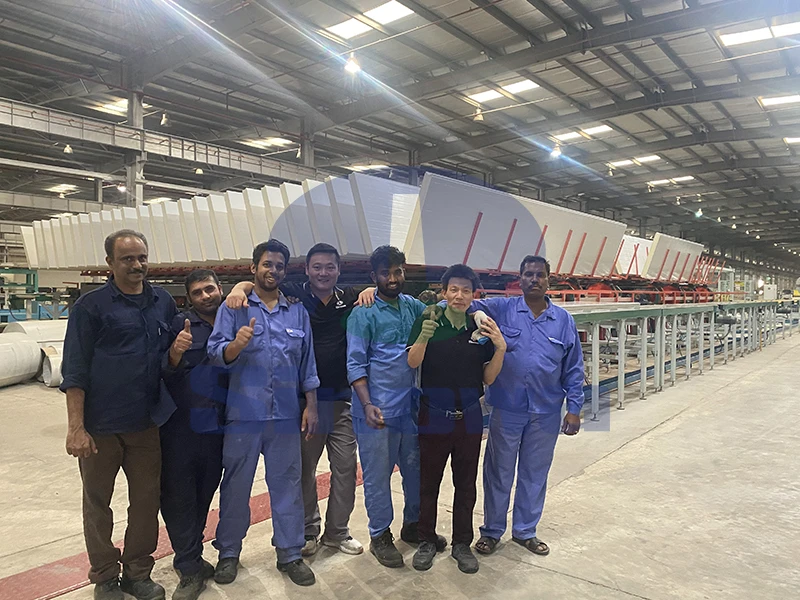
PIR foam panel production line represents a sophisticated continuous manufacturing system built to create composite insulated panels with rigid polyisocyanurate foam cores. Unlike batch production methods, this integrated setup connects every functional module into one synchronized workflow, minimizing manual handling and reducing inconsistencies that often appear in discontinuous manufacturing. The whole system is designed to transform raw chemical ingredients and metal facer coils into finished sandwich panels in a single uninterrupted run. Operators oversee the whole process through a central control interface, adjusting line speed, temperature and material ratios according to real-time feedback from sensors installed across the machine framework. Every section must maintain precise coordination, because a slight mismatch between the movement speed of surface materials and foam reaction timing can create uneven foam density, poor bonding or internal voids inside the panel core. This continuous design also improves overall throughput compared with mold-based production, making it suitable for large-volume manufacturing of insulated panels used for building envelopes and temperature-controlled structures.
The first operational segment of the line handles facer material unwinding, surface preparation and roll forming. Metal coils are mounted on unwinding racks, feeding continuous sheets forward into leveling devices that eliminate wrinkles and uneven tension. Surface cleaning and preheating units prepare the sheet surface to enhance adhesion between the metal substrate and expanding PIR foam. Roll forming stations shape flat metal strips into custom profiles, creating interlocking edge structures that help finished panels connect tightly during installation. The upper and lower facer sheets travel along separate conveyor paths before reaching the pouring zone, and their moving speeds are locked to match each other to avoid stretching or misalignment. This preparation phase is easy to overlook, yet it directly affects long-term panel quality. If surface contaminants remain or temperature is inconsistent, the foam may separate from metal facers later, leading to delamination failures after installation.
Raw chemical storage and precision metering form the chemical heart of the PIR foam panel line. Multiple storage tanks hold polyol blends, isocyanate, blowing agents, catalysts and surfactant additives, each kept under stable temperature to preserve chemical activity. High-pressure metering pumps deliver each component at accurately controlled flow rates into the mixing head, where all streams combine rapidly just before pouring onto the lower facer sheet. PIR chemistry requires a different component ratio than standard polyurethane foam, supporting trimerization reactions that build the thermally stable molecular structure unique to PIR materials. Small variations in proportion will alter foam cell structure, mechanical strength and thermal performance. The mixing head sprays the blended liquid evenly across the width of the moving facer, distributing material uniformly so foam expands consistently between the two metal layers without concentrated pockets or unfilled gaps.
After chemical pouring, the material enters the double-belt laminating tunnel, where foam expansion and composite shaping take place. As the liquid mixture reacts, heat releases from polymerization, activating the blowing agent and generating countless tiny closed cells inside the polymer matrix. The upper and lower moving steel belts apply steady pressure and maintain a fixed gap to define the final panel thickness. Temperature control inside the tunnel supports the full trimerization reaction needed for PIR formation, preventing incomplete curing that weakens foam performance. The expanding foam bonds firmly to both upper and lower facers while confined within the controlled space between belts. Synchronized belt movement carries the developing composite steadily forward, holding flatness and dimensional stability during the critical foaming stage. Any fluctuation in pressure or temperature at this stage can cause uneven thickness, distorted profiles or inconsistent cell distribution throughout the foam core.
Once the continuous composite exits the laminating tunnel, it moves through a gradual cooling zone to stabilize internal stress. PIR reactions generate substantial internal heat, and rapid cooling can create thermal stress that leads to warping or internal microcracks. The cooling section lowers panel temperature step by step, allowing residual chemical reactions to finish slowly while the foam matrix hardens completely. Sensors monitor surface and core temperature along the conveyor path, adjusting airflow and heat dissipation to maintain uniform cooling across the full panel width. During this phase, the foam core continues to gain mechanical rigidity, and interfacial bonding between foam and metal facers reaches its final strength. Panels cannot move directly to cutting immediately after lamination. Insufficient cooling leaves residual heat inside the foam, which may continue reacting after cutting and deform finished panels during storage.
Fixed-length cutting and edge trimming come after cooling, converting the endless continuous panel into individual finished pieces. A traveling cutting device moves in sync with the running panel during cutting, avoiding speed mismatch and jagged cut edges. After cross-cutting to target lengths, edge trimming units remove excess material and machine the panel edges to clean, precise profiles that fit assembly requirements. Trimming also removes areas where foam overflowed during expansion, ensuring consistent width and straight edges for seamless panel assembly. Waste scraps generated during cutting and trimming can be collected for further handling. At this stage, inspection systems check surface appearance, dimensional accuracy and flatness, flagging panels with visible defects before they proceed to stacking. This automated cutting process delivers higher repeatable precision than manual cutting and keeps production flow uninterrupted.
Automatic stacking and material handling form the final production segment of the PIR foam panel line. Completed panels transfer from the cutting area to stacking stations, where mechanical grippers lift and arrange panels neatly onto support pallets. The stacking mechanism carefully separates each panel layer to prevent surface scratches and compression damage to the foam core. Palletized stacks move toward the finished goods zone, where panels continue a short secondary curing period before shipment. Operators check batch consistency and log production data for each run. Automation in this stage reduces physical labor and lowers risks of panel damage caused by manual lifting and handling. Efficient stacking also optimizes warehouse space and simplifies loading for transport, protecting panel integrity until they arrive at project sites for installation.
Advancements in control and monitoring technology keep modern PIR foam panel production lines stable and adaptable. The central control system records process parameters including line speed, chemical flow rates, tunnel temperature and belt pressure throughout each production run. Historical data helps operators trace quality issues and fine-tune recipes when switching to different panel thicknesses or facer materials. Modular equipment layout allows partial upgrades without full line shutdown, supporting flexible production schedules for varied panel specifications. While the line demands careful maintenance of pumps, mixing heads, belt systems and temperature sensors, proper upkeep extends service life and reduces unexpected downtime. As demand for high-performance thermal insulation continues to grow, the PIR foam panel production line remains a reliable manufacturing solution for energy-efficient building materials, balancing high productivity with stable product performance across diverse application scenarios.
Gallery of PIR Foam Panel Production Line






Tags: pir foam panel production line, pir foam panel production line manufacturer, pir foam panel production line supplier, china pir foam panel production line, pir foam panel production line for sale
https://www.sandwichpanelmachinery.com/blog/pir-foam-panel-production-line.html
-

The PU sandwich panel line is a core production setup for making high-performance building insulation panels. This professional PU sandwich panel production line features automated operation to streamline the whole manufacturing process efficiently. Every component of the polyurethane sandwich panel line is precisely calibrated to ensure consistent panel thickness and structural stability. A well-maintained polyurethane sandwich panel production line can greatly boost production efficiency while reducing manual operation errors. The continuous PU sandwich panel line adapts to diverse production demands for different panel sizes and surface styles. With advanced molding technology, the PIR sandwich panel line produces panels with excellent heat preservation and sound insulation properties. Stable running of the PIR sandwich panel production line guarantees reliable product quality for various construction and industrial application scenarios.
-

A phenolic insulation board production line serves as the core equipment for manufacturing high-performance thermal insulation building materials. This phenolic insulation panel production line integrates material mixing, foaming, molding and cutting processes to ensure continuous and stable production efficiency. Every operational link of the insulation board production line is precisely calibrated to produce uniform and durable insulation boards. The automated design of the insulation panel production line effectively reduces manual intervention and improves product consistency. Proper maintenance of the phenolic board production line can greatly extend its service life and maintain steady production output. With optimized structural design, the phenolic panel production line adapts to various production demands and delivers high-quality finished products for thermal insulation engineering applications.
-

A professional rockwool sandwich panel line serves as the core equipment for producing high-performance building panels. This rockwool sandwich panel production line integrates feeding, laminating and forming processes to ensure stable and efficient production. The well-structured rock wool sandwich panel line can process raw rockwool materials into panels with excellent thermal and sound insulation properties. Operators can adjust the running parameters of the rock wool sandwich panel production line to manufacture panels of different thicknesses and specifications. The automated design of the mineral wool sandwich panel production line greatly reduces manual operation errors and improves product consistency. Regular maintenance of the mineral wool sandwich panel line is essential to sustain long-term operational efficiency and guarantee qualified finished panels for diverse construction applications.